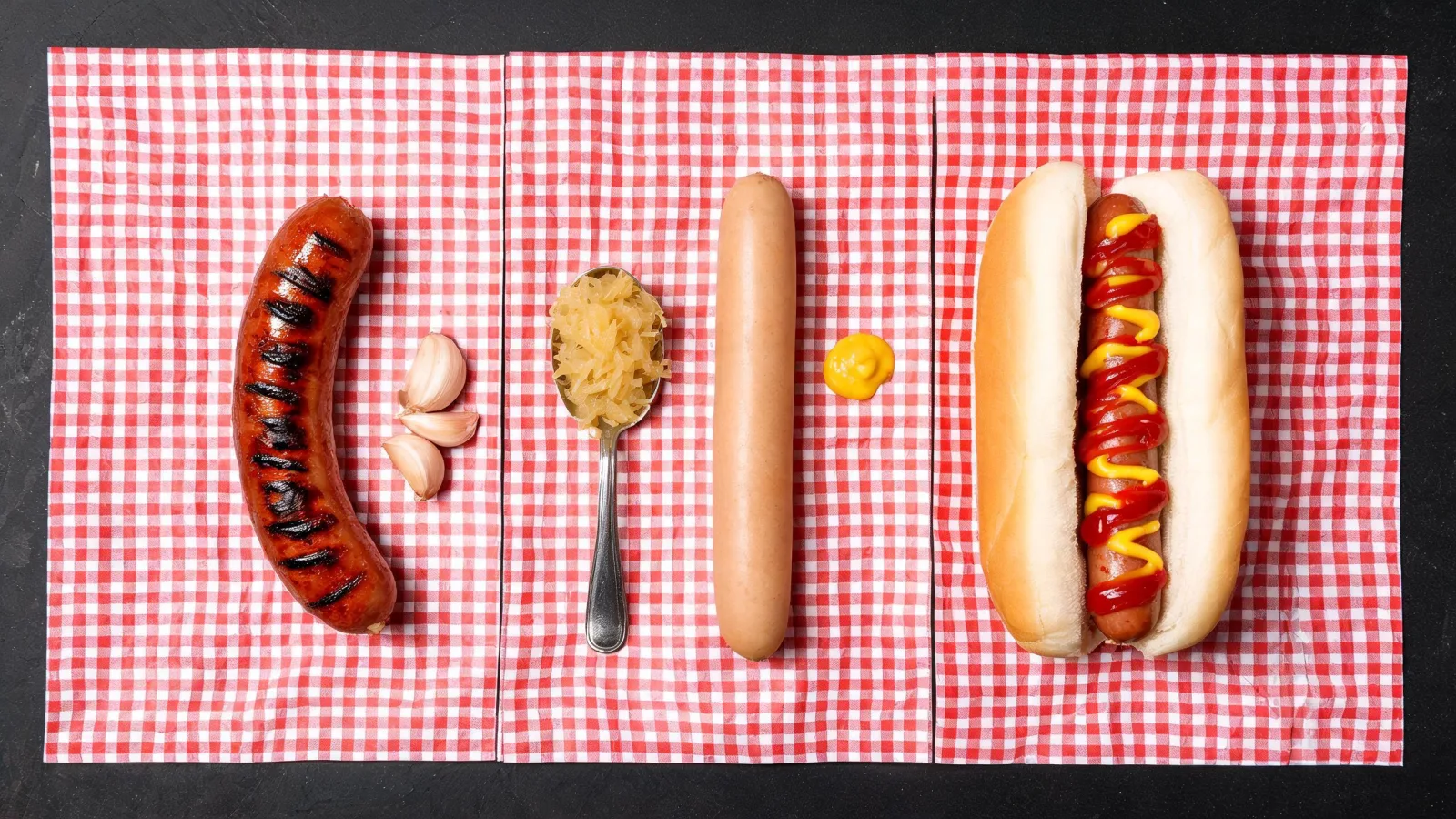
People ask us all the time: isn't a hot dog just a sausage? It is, technically. But it's made and eaten very differently from the Taiwanese sausage grilled at night markets or the sausages hanging in a German butcher shop. Here's how the three compare, with a table at the end.
Short answer: a hot dog is one kind of sausage
Sausage is a huge family: grind meat, season it, stuff it into a casing. The American hot dog is one branch, with a clear legal definition in the US. Taiwanese and German sausages are two other branches with their own methods. Four things tell them apart: how fine the meat is ground, how it's seasoned, whether it's sold raw or cooked, and how people usually eat it.
American hot dogs: finely ground and already cooked
US federal regulations (9 CFR 319.180) group frankfurter, frank, hot dog and wiener under one standard, in the Cooked Sausage subpart. The key points:
- Finely ground: the rule says comminuted and semisolid, meaning a smooth meat emulsion. That's why a hot dog is evenly pink inside, with no visible bits of fat.
- The meat: livestock meat like beef or pork. Poultry can be added, but a standard hot dog can't be more than 15% poultry.
- Limits on fat and water: no more than 30% fat in the finished product, and fat plus added water can't exceed 40% combined.
- Seasoned and cured, smoked or not.
Because it's already cooked, a hot dog only needs to be steamed, simmered or grilled until hot before it goes in the bun. Toppings vary a lot across the US; New York, Chicago and Detroit each do it their own way.
German sausages: so many that you sort them by method first
The hot dog's roots are in the German-speaking world. There are so many German sausages that they're usually grouped by how they're made:
- Brühwurst (scalded sausage): raw meat is ground, stuffed, then heated through. Frankfurters and wieners belong here, and they're the ancestors of the American hot dog.
- Rohwurst (raw sausage): never heated, preserved by fermenting and curing. Salami is the classic example.
- Kochwurst (cooked sausage): the ingredients are mostly cooked before stuffing, like liver sausage and blood sausage.
Two names you'll hear most:
- Frankfurter Würstchen: traditionally pure pork, long and thin, in a sheep casing. Since 1929, Germany has only allowed sausages made in the Frankfurt area to use the name.
- Wiener: according to Austria's agriculture ministry, butcher Johann Georg Lahner, who moved from Frankfurt to Vienna, first made it in 1805 by finely grinding pork, beef and back fat, stuffing it into sheep casing, lightly smoking it and then scalding it. In Germany, this pork and beef version is called Wiener Würstchen.
Then there's bratwurst, a sausage usually meant for the pan or the grill. Some are sold raw and must be cooked through, others come pre-scalded. The package label is your best guide.
In the 19th century, German immigrants brought these sausages to America, where they slowly turned into the hot dog in a bun.
Taiwanese sausage: sweet, chunky, and sold raw
Taiwanese sausage (xiangchang) goes in a completely different direction:
- Pork, coarsely ground: you can see and taste little pieces of fat and lean meat, and the texture is chewier.
- Sweet and savory: sugar is a given, and kaoliang liquor, five-spice, cinnamon and white pepper are common. A home sausage recipe published by Taiwan's Ministry of Agriculture lists exactly those: sugar, five-spice, cinnamon, kaoliang liquor and white pepper.
- Usually raw: packaged Taiwanese sausages are often labeled not ready to eat, to be fully heated. Pan-fry, grill or steam them until cooked through.
- How it's eaten: charcoal-grilled at night markets, often with a clove of raw garlic on the side, or tucked into a sticky rice sausage as "small sausage in large sausage."
The differences in one table
| Compare | Taiwanese sausage | German sausage | American hot dog |
|---|---|---|---|
| Meat | Mostly pork | Depends: frankfurter is pure pork, wiener is pork and beef | Beef, pork, etc., small amount of poultry allowed |
| Texture | Coarse, with bits of meat | Scalded sausages are fine; bratwurst is coarser | Smooth emulsion, even inside |
| Seasoning | Sweet and savory, often liquor and five-spice | Salt, pepper, spices; savory | Savory, may be smoked |
| When you buy it | Usually raw | Scalded types are cooked; bratwurst can be either | Already cooked |
| Typical way to eat | Grilled with garlic, or in sticky rice sausage | With mustard, sauerkraut and bread | In a long bun with sauces and toppings |
So which one is Hotdogray?
Hotdogray is all American hot dog: a big American-style sausage in a steamed bun, topped with our signature chili or other toppings. Not Taiwanese sausage with garlic. When we started as a street stall in Zhongshan District in 2017, many of our regulars were Americans living in Taiwan, and the taste of home is what they were after.
To taste the basics first, order the Original Hot Dog, NT$50 (ketchup, mustard, sauerkraut), the closest thing on the menu to the old German pairing of sausage and kraut. For the signature, get the Chili Dog, NT$70. See the full menu, and how a handmade hot dog compares with a convenience store one in this guide.
FAQ
Q: Is a hot dog a sausage?
A: Yes. US federal regulations put frankfurters, hot dogs and wieners in the cooked sausage category: finely ground meat, already cooked before it leaves the plant.
Q: What's the biggest difference between Taiwanese sausage and a hot dog?
A: Taiwanese sausage is usually coarsely ground with visible bits of fat, seasoned on the sweet side, and mostly sold raw, so it has to be cooked through. A hot dog is a smooth, fine emulsion that's already cooked; you just heat it.
Q: Are frankfurters and wieners the same?
A: Very close. Both are scalded sausages from the German-speaking world. The traditional Frankfurter Würstchen is pure pork, while the Vienna style uses pork and beef.
Q: Is Hotdogray's hot dog Taiwanese or American?
A: American. A big American-style sausage in a steamed bun, topped with our signature chili or other toppings, not Taiwanese sausage with raw garlic.